Tuesday, June 4, 2013

Shamanic Journey in Today's World

Direct Experience with the Sentient Universe

Excerpts from Part 3 in Earth-Spirit Series by Sandra Cosentino, M.S.

Shamanism--the mystical path of direct experience with the sentient universe--is the worlds' oldest form of communion with Source and is based on a deep, living relation to Nature and inner pathway seer skills. The modern day seer uses archetypal pathways of the soul adapted for today's world. A new shamanism right for today's times is being created by peoples from modern cultures.

These direct experiences of expanded reality shift perceptions and create new neural pathways. New insights flow in that support conscious re-creation of your life in a frequency more aligned with your soul. Each of us has the ability to develop these skills, once the primary domain of the designated "Medicine Man/Woman".

Soul flight/shamanic journey practices are very much alive and thriving in today's world. These are natural, innate talents that can be developed and are compatible with all spiritual traditions. These directly felt experiences beyond our daily understanding potentialize a shift in your inner vibrational field into new possibilities. And collectively, we are contributing to our own species' conscious evolution. 

Ancestral Hopi rock art of Shaman working with
Dragonfly spirit (on his shoulder) to evoke water energies.

Be Your Own Shaman-Seer Insight Retreats
Sandra Cosentino has developed these mentoring experiences based on a lifetime of exploring and connection to the energies of wild nature, and 3 decades of experience with ceremony, lucid dreaming, vision quest, mindfulness practices, meditation and insight retreat facilitation. She has been working with shamanic journey for more than 20 years with a dedication to empowering others to be their own Seer.


Saturday, March 9, 2013

Call of the Southwest CanyonScapes


by Sandra Cosentino
(photos by Sandra Cosentino except where noted) 

Grand Canyon sunrise by Sandra Cosentino
These canyons and cliffs evoke a visceral level response in us. 
Our very smallness relative to the landscape is humbling.  
Yet you sense expanded horizons of who you really are.


Primordial Force of Nature

Sedona, Arizona resonates with the heart beat of the earth. There is a presence here that quickens your senses, that calls you home. It is a gateway into the Colorado Plateau, the second largest plateau in the world. A place of mysterious beauty, it is alive with Creation stories and with eons of the Earth's creation exposed in sinuous red and white canyons. A primordial force of crystalline rock embedded with prayers from many millenia of humans honoring this sacred earth, her energies vibrate at a cellular level in those who come in pilgrimage.

The Colorado Plateau is connected to the center of the backbone of Mother Earth, the Rocky Mountains, which extend from Alaska to Chile in a north-south direction. On the opposite side of the earth is the Tibetan Plateau, largest in the world, connected to the east-west chain of the Himalyas. These two great mountain chains form a cross of the 4 Directions. It is no coincidence that two ancient mystical cultures--the Tibetan Buddhists and the Hopi Indians--were guided by Creator to anchor and enhance these powerful natural energies.


painting by JohnSteele: 
We Bring the Rains
Still today, the Hopi priests place offerings at ancestral prayer shrine sites all over the region including the Sedona area. The Hopis, the most traditional tribe in North America, settled on the Plateau after thousands of years of migrations to this their place of center. Their presence enriches my experience of this land as an ancient sacred place. And reminds me that we today too have a role to remember our reciprocity to our giver of life, Mother Earth.

Here, elemental forces sculpt a dreamscape radiant with sun, quickened by lightning. The wind that shapes the wondrous formations gives voice to the indwelling life that Navajos call Nilchi'i, the inner spirit of humans, the mountains, the stars and all of creation. It's easy to have that experience of having left the ordinary world behind and stepping into the non-ordinary world. Here ancient knowing is stimulated. Who are we? Why are we here now.

The Mystic's Path of Direct Experience

Exploring Sedona by Teresa Settles
Trips into the world of wild nature and Native cultures of the Colorado Plateau open people to a felt experience of empathetic unity, which is central to indigenous thought and being. Wild beings, trees, canyons, streams have a consciousness that communicates with us in dreams, vision and daily life in a thousand unseen energetic patterns or resonances. Moving fast, living in our head, we in the Western world seem to have lost touch with direct knowing of the heart, of trusting our own instincts. Subtle signs come to us constantly from nature, in our dreams, in the words of friends and co-workers. Do we slow down enough to listen?

We are vaster than our mind, than our body. And in the purity of wild nature we have a direct pipeline to Source. As you relax, quit thinking and doing and just be alive to the moment, Nature always gifts us. With every in-breathe light energy from the stars, the sun, the mountains feeds you. With every out-breath, the whole of the cosmos knows you.
Sedona photo by Sandra Cosentino


This path of direct knowing has always called me.  Nature called me to move out of the city to the mountains after college and became a doorway to realignment of my psyche and seeing new possibilities.  During this time in my twenties, while out on the land, I received my first conscious messages from Spirit that helped me shift out of limiting beliefs and set me on a life long path of spirit connection.

Countless times, I have known an animal was there before seeing them, looked in wild bird and animal’s eyes, felt wind swirls at auspicious moments, sensed myself breathing with a mountain, had lucid dreams with direct communication from animal helpers and wild places, looked with awe and gave thanks to rising sun, and felt sun and star energy as an internal fire.  We live in a sentient world, all connected to the greater field of consciousness. 

I share pathways of the modern day mystic with guests to this land, drawing from timeless principals; such as: developing attentiveness to energies and signs flowing within nature and us, becoming your own shaman-seer traveling on the wings of your intention and focused attention, and using ceremony to activate your intention and rebalance. 

recent Sedona Ancestor Wisdom Circle
 with Martika of Columbia and guests from Australia
We go out at dawn, sunset and under the stars--each time of day with its own sensory qualities. Circles with our Hopi, Navajo and other Native American friends deepen for us this ancient sense of being part of the greater circle of life. 

We are part of the living body of the Earth—her vibrational frequency, like ours, is increasing.  Direct experience of her energies, grounds and renews us.  Her beauty fills our heart with awe and wonder.  And for the mystic, nature is a portal to expanded awareness.


Answering the Call of the Desert:
"Upon my arrival, a mutual friend introduced me to Sandra Cosentino, owner/operator of Crossing Worlds Journeys & Retreats based here in Sedona. Through excursions of the heart-- Medicine Wheel ceremonies, drum journeys and cultural explorations into Hopi and Navajo Indian country, Sandra helped me deepen and further the bond I had with the wild magic here-- this ancient land that had courted me from the thick-treed slopes of the Northwest into the soaring rock and wrinkled hills of the Southwest.
We often don't have any precedent in our lives that suggests that this kind of connection is open to us; don't know anyone who has these interactive dialogues with Nature, with the wild energies of wind & rock and the ancient voices of the ancestors. Sandra has been in dialogue and soulful connection with this ancient land all of her Life. By example she helped me trust this seemingly unorthodox conversation I had entered into with this place and welcome the Mystery to enter into me."
Shay Panther, 2002


Sandra Cosentino, native to Arizona, created Crossing Worlds Journeys in 1991 to share her intuitive insights and informed passion for the spirit, lands and cultures of the Colorado Plateau. Her lifelong mystical relation to Nature led her to sharing of friendships and knowledge with Native peoples of the Southwest, Peru and Alaska and with universal wisdom keepers of many paths. She conducts journeys, retreats, and earth-spirit experiences in Sedona, Hopi and on Navajo lands in Canyon de Chelly and other places of natural power and beauty on the Colorado Plateau for individuals and groups from around the world . A former teacher with an M.S. in Natural Resources Planning, she has worked as a natural resource manager for the State of Alaska and for Native tribes in Alaska and Arizona

Please see:  Crossing Worlds Journeys for Sedona and Colorado Plateau experiences, images and articles

Sunday, July 15, 2012

Attention...A Core Mystical Perception Skill


Second in a series on Earth-Spirit Ways
By Sandra Cosentino, M.S.

Attention is a powerful skill used by mystics, modern and ancient, to expand awareness of energies and open to perceiving new insights. The practice of focused attention to subtleties can expand perceptual, direct knowing. Ancestral peoples had deep observational abilities of the cycles of nature and celestial realms, for example, that gave birth to astronomies and spiritual practices to work with these natural energies to enhance their lives. Confidence and inner knowing arise from paying attention.

"Attention is the cognitive process of selectively concentrating on one aspect of the environment while ignoring other things. Attention has also been referred to as the allocation of processing resources." (Wikipedia)

"Holding deeper attention is all it takes to illumine what is invisible." (Llyn Roberts)
Once I looked directly into a bear's eyes in the wild--that image of focused attention is forever burned into my psyche.


Please see full article and Southwest images here:
 http://www.crossingworlds.com/articles/attention.html

Tuesday, May 8, 2012

Creosote Bush: Ancient Desert Shrub That Smells Like Rain

Hardy Pleistocene Invader - Volatile Leaves - Medicine Plant - Bees Partner
article by Sandra Cosentino

"The desert is unpredictable, enigmatic.   One minute you will be smelling dust.  The next, the desert can smell just like rain." (Gary Nabhan from The Desert Smells Like Rain)

Following recent spring rains in the lower desert parts of central Arizona, my nose was overwhelmed with the heavy pungent scent of the aromatic creosote volatilized by the rain. The air was thick with palpable presence of creosote--enveloping me in a blanket of life-opening-to-moisture energy.  As a native Arizonan, this smell is a positive imprint that means rain!  I instinctively felt energized. I have always taken creosote presence for granted, but decided this spring, resin-scented day to get to know more about this iconic desert shrub.

Until we take time to really look, how little we know of the intricate lives of the plant and animal beings that surround us. Even in our urban cocoons, we are woven within complex ecosystems exquisitely adapted to our local soils, light, moisture and temperatures. On a cellular level we are in vibration with these qualities of place in every moment. Only our busy minds take us away from this direct knowing. What lessons do they have for us to thrive and adapt to change?

Please see rest of article with images here


Tuesday, April 3, 2012

Grand Canyon South Rim: Images of Early Days of Tourism

Grand Canyon Fever
Lookout Studio was constructed
 by the Santa Fe Railway in 1914
 to compete with Kolb Studio
 (2012 image by S. Cosentino)
by Sandra Cosentino


The passion and fervor to create tourism access to the Grand Canyon is equally matched by the awe and magnetism this grand chasm evokes in people who now come from all over the world.  Considering the remoteness and lack of development in Northern Arizona in the late 1880's and early 1900's, the pace of tourism development on the South Rim was astounding.  These historic structures add to the richness of the visitor experience today and fire our imaginations.


Please see gallery of 18 historic images of this early tourism at the Grand Canyon. Click here.


Flagstaff and Phoenix were established in the 1860's less than 20 years after obtaining the land from Mexico.  The railroad did not come to Flagstaff until 1882.  Stagecoaches started bringing tourists to Grand Canyon the next year. Despite the lack of access, enterprising Americans knew this was going to be a major attraction.  All of the early roads from Flagstaff, Williams and Ash Fork to the South Rim were built by canyon pioneers (by the 1920's  these were taken over by Coconino County).  


Arizona had territorial status from 1868- 1912.


In 1872 John D. Lee opened the first ferry service over the Colorado River near the eastern entrance to the Grand Canyon.  Harrison Pierce in 1876 opened a ferry service on the western end.


The 1880's was the heyday of the first South Rim tourism entrepreneurs:


1884-1889 the two-room Farlee Hotel opened near Diamond Creek.
1886 John Hance opened his ranch near Grandview to tourists.
1889 Louis Boucher opened a larger hotel at Dripping Springs. 
1890 miner William Bass opened the first tourism tent camp on the  South Rim 20 miles west of today's Grand Canyon Village and operated a stage service to his camp.


Peter Berry, a "miner"/would-be tourism operator built the Bright Angel Trail in 1891 and the mule ride tradition began.  Enterprising Ralph Cameron bought these "claims" that year and began charging visitors $1 per head toll up until 1912, the year of Arizona becoming a state. 


In 1896 the Bright Angel Lodge in what is now Grand Canyon Village opened by James Thurber who ran a stage line from the Grandview area to this new location at the head of Bright Angel Trail.


By 1901 the Santa Fe Railroad developed a spur to the Grand Canyon and was beginning their tourism infrastructure development in association with the Fred Harvey Company.  Politician Ralph Cameron fought the railroad for years to keep his exclusive access via his hundreds of unpatented mining claims so he could mine the tourism dollars.  The railroad hired artists to paint the canyon to stimulate public fervor to visit this natural wonder.  And the Fred Harvey Company early on used Native American people and their art as part of their tourism attraction.  


In 1902 the Kolb brothers began popularizing photographic images of adventures in the Canyon and building their tourism studio. 

1912 photo Kolb Studio which overlooks Bright Angel Trail


1902 was also the year the first auto made it to the canyon rim.  
Rim tours by horse-drawn carriage were flourishing. (see historic photo gallery link above)


Hopi House built 1905,
designed by Mary Jane Colter.
2012 photo by Sandra Cosentino
In 1905 the Fred Harvey Corporation opened up the elegant El Tovar and the rustic Hopi House side by side.  Hopi and Navajo people would dance outside daily.  The Corporation required that one of them wear a Plains Indian headdress since this was the stereotypical image of what an Indian looks like.

El Tovar built 1905
2012 image by Sandra Cosentino


By 1908--the year Grand Canyon National Monument was designated-- the first cable was placed over the Colorado River in the bottom of the canyon and the development of the Phantom Ranch tourism camp began.   


In 1912, the West Rim Drive was completed and then in 1914, Hermit's Rest, another Mary Jane Colter design, was built at the end of Hermit's Road as a tourist rest spot with food and restrooms.
Hermit's Rest, built 1914

1920 Hermit Road Tour
The North Rim was accessible only from Utah and only during the summer months due to its much higher elevation than the South Rim, thus tourism did not get a foot hold there prior to national park designation.  The Wylie Way Camp operated from 1917-1927 when the Park Service cancelled its permit.
Wylie Way Camp, North Rim, 1917-1927
In 1918 the Grand Canyon officially became a national park. In the late 1920s the first rim-to-rim access was established by the North Kaibab suspension bridge over the Colorado River and  Phantom Ranch was expanded in only two years later.
In 1920 Arizona had about 300,000 population, only 20 private auto registrations and northern Arizona was still very much a frontier with no paved roads.  Still, in that year, visitation to the Grand Canyon reached 67,315.  


Peach Springs, south of Grand Canyon on Rt. 66, 1928


By 1926 more people were coming by auto than train.  By 1927 Arizona auto registrations rose to 82,000.  Route 66 did not come through northern Arizona until 1920's and it was narrow, crooked and poorly surfaced all until paving was put in by 1938.

Original North Rim Lodge, 1930


On the North Rim, the Grand Canyon Lodge opened in 1928 under exclusive concessionare contract to Utah Parks Company, a subsidiary of the Union Pacific Railroad.  It was closed by a fire in 1932 and reopened in 1935.
North Rim Grand Canyon Lodge, fall 2011 by Sandra Cosentino
Ruins of first North Rim Lodge, 1935


The opening of the Navajo Bridge in 1929 created the first road connection of the North Rim to the rest of Arizona.  This was a major event.
Opening of Navajo Bridge in 1929


During the 1930's the CCC did major trail, communication and structural development work in the Grand Canyon National Park that really made a difference in accessing the interior of the Canyon.  (please see historic images of this in photo gallery)


On 2nd floor of Desert Watchtower Hopi artist Fred Kabotie
painting of pilgrimage to source of the waters to
obtain the rain making Snake Dance ceremony.


Desert View Watchtower, also known as the Indian Watchtower at Desert View--a 70-foot  stone building by Mary Colter completed in 1932--overlooks the great bend of the Colorado River on the east side of the Grand Canyon.  Inspired by prehistoric towers, Colter hired Hopi artist Fred Kabotie to paint Puebloan murals and even installed an alter of the Snake Clan.  Hopi ancestors used to farm on the Colorado river delta below and the Hopi place of emergence into this, their fourth world, is at this end of the Canyon.  A Hopi priest I know told me that he believes the reason the tribe has allowed the altar to remain in public view on the second floor of the tower could have something to do with the sacred sites below.


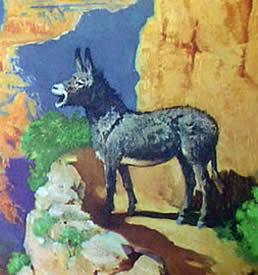
Brighty of the Grand Canyon, published in 1935 by Marguerite Henry, is a fictionalized account of a real-life burro named "Brighty", who lived in the Grand Canyon of the Colorado River from about 1892-1922.  It quickly became a classic part of the lore of the Grand Canyon and added to the popularity of the Grand Canyon mule ride.


And still today, people come and stand in awe on the rim or hike into the depths.  Unlike 100 years ago visitors can now rent mountain bikes, take a bus shuttle,  and helicopter and river raft tours.  But they spend less time just being in the wonder of it all than did the early day adventurers.


-------------
Sandra Cosentino, native to Arizona, has been visiting the Grand Canyon all her life and the Canyon is a rich part of her inner and outer landscape.
See info on her tours here:  http://www.crossingworlds.com

Thursday, March 22, 2012

Fluttering of Butterfly Wings Ripple in My Soul

Desert Butterly Garden Magic
words and images by Sandra Cosentino inspired by Butterfly Beings
March 22, 2012


Fluttering wings of dozens of butterflies gently are silently rippling around my energy field as I enter this butterfly haven amid the desert garden.  Mesmerized, I am drawn into their delicate, ephemoral world.  Wings spread with backs to the sun on this cool desert morning act as solar collectors create a luminous display that dazzles my eyes.  I feel as though I am in a fairy kingdom.

This adult stage of the butterfly may only last a week or two although a few species live up to 18 months.  They will lay eggs that become caterpillars the pupate in their woven chrysalis hanging on twigs.  It is here in the chrysalis shell that the caterpillar's structure is broken down and rearranged into the wings, body and legs of the adult butterfly.  One of Nature's miracles of transformation.

This butterfly magic evokes the heart of the mystical child that lives within.  Hope softly unfurls in a spontaneous flutter inside by being.   Entranced, I can't help but smile.

Butterflies move with grace and eloquence.  And inspire us to move with flow through the turns and shifts of Life that mold us into ever more refined expressions of our soul's presence.  May we emerge from our transitions as luminously as the butterfly.

Please see more images:  www.crossingworlds.com/articles/butterflygarden.html

Tuesday, February 28, 2012

Nature Mysticism


by Sandra Cosentino, M.S.
Part 1 in Earth-Spirit series

Aspects of mystic connection are explored along with photos from Arizona and Alaska.  Opening and closing paragraphs below.

A Nature Mystic enters into conscious communion with the elements of the natural world.
In a state of expanded now awareness, you sense/invite a merging with vibrational energies from the stars, the earth, the trees, the waters, the bird and animal beings.  As you enter this greater field of energy, you then see through the eyes of your Higher Self and enter a timeless realm Aboriginals call the Dreamtime.  You are awake, yet in an expanded state of consciousness where direct knowing can flow in.  A joyous sense of being part of the larger plan of life often arises spontaneously.

We are part of the living body of the Earth—her vibrational frequency, like ours, is increasing.  Direct experience of her energies grounds and renews us.  Her beauty fills our heart with awe and wonder.  And for the mystic, nature is a portal to expanded awareness.
Tassili Desert
I use this image from the Sahara to give the feeling of early Christian monks practice of seeking “apatheia” (meaning “beyond every image”) in the desert which is mentioned in the article.  

Please see full article:  click here

Young caribou sees me
A young caribou on fall southward migration at Kobuk River portage, Alaska, who spots me laying there in the bushes next to her.


Sandra, an Arizona native and life long Nature lover-explorer, is the founder of Crossing Worlds Journeys &; Retreats, Sedona, AZ since 1991 following her return from 10 years in Alaska.


Experiences related to this theme you might want to consider:

Nature Writing Awareness - Writing - Storytelling: click here 
Mystical Nature Shamanic Journey: click here
Earth and Sky Speak to Us seminar on the land: click here


Thursday, November 10, 2011

Positive Change -- Desert Light Images

by Sandra Cosentino

11-11-11 to me conveys a sense of positive change as millions around the world are treating this as a special day of ceremony.  I think of this as a global version of what humans have done in village groups throughout time.  In the coming together with shared focus, energy moves, gets recreated.

"When we turn to spirit within, an alchemy is released..allow it to flow through you and out to your community and become a point of light in global transformation."  Rev. Bruce Kellogg (Verde Valley, AZ) sees this Friday as an opportunity for each person to recognize their worth thereby fanning the flames of love in your own heart which then ripples out and flows where it needs to be in the universe.

I send you energies and images of light from Southwest Desert lands:
unearthly turquoise and peach colors of high desert sunset

Dale Terbush Desert Twilight painting
Dawn twin balloons rising near Boynton Canyon, Sedona

Double rainbow over the vast Hopi landscape


Sunday, June 26, 2011

Wild Places Charge our Imagination


Perceptions of the Southwest canyon horizons by Sandra Cosentino
With quotes from Terry Tempest Williams-- talented writer, naturalist, conservationist
Grand Canyon sunrise photos above and below by Sandra Cosentino June 9, 2011

Vivid imprints of times exploring in wilderness places such as remote Alaska and the canyon country of the Southwest are indelibly etched on the fabric of my being. A certain kind of quiet knowing, inner courage and ecstatic joy of connection was forged within me on those many sojourns.  At the Grand Canyon this May, I had the joy of listening to Terry Tempest Williams read with informed passion from her book Red: Passion and Patience in the Desert as we sat in an outdoor theatre.

Please also see my new 3.6 minute video Grand Canyon Dawn - The Magic Time  with a Hopi sunrise song (we welcome to subscribe to our Youtube site).

She speaks of finding your own equilibrium in the harshness of the desert.  “What you come to see on the surface is not what you come to know.  Emptiness in the desert is the fullness of space, that eliminates time.  The desert is time, exposed time, geologic time.  One needs time in the desert to see.”


Here on the rim of the Grand Canyon in the dark watching the stars move overhead I am newly aware of how expansive the view of horizon is -- in stark contrast to dark abyss below.  Just as the first deep golden dawn light showed on the east rim, Venus appeared bright white slowly rising.  I stared spellbound.  Venus is twenty times brighter than Sirius, the brightest star in the sky. No wonder the ancestral peoples of the Southwest were skywatchers.  At high altitude with dry air there is less atmospheric distortion.  Big canyon rim and plateau vistas are capped with a luminous dome of stars. Awestruck, I am drawn spellbound into silent communion.

Pre-western cultures were “deeply attuned to the motion of the sun, moon, and planets, and they used their naked-eye observations to create not only intricate astrologies and mythologies - in particular, those revolving around Venus - but also extremely accurate records and projections of meteorological phenomena,” according to Anthony F. Aveni in Conversing With the Planets: How Science and Myth Invented the Cosmos. You may want to ponder these questions he asks:  “What have we moderns lost by turning our attention to the cold eye of the telescope, away from the natural harmonies of planet and sky? Why have we silenced the dialogue between observers and the sky?"

These canyons and cliffs evoke a visceral level response in us.
Our very smallness relative to the landscape is humbling.
Yet you sense expanded horizons of who you really are.

Terry (photo to left from her Grand Canyon appearance 5-21-11) characterizes vividly the expansive effects of desert sojourns on the psyche:  “this is Coyote’s country—a landscape of the imagination, where nothing is as it appears.  The buttes, mesas, and redrock spires beckon you to see them as something other:  a cathedral, a tabletop, bear’s ears or nuns.  Windows and arches ask you to recall what is no longer there, to taste the wind for the sandstone it carries.  These astonishing formations invite a new mythology for desert goers, one that acknowledges the power of story and ritual yet lies within the integrity of our own cultures.  The stories rooted in experience become beads to trade.  It is the story, always the story, that precedes and follows the journey.”
Arches National Park, Utah--near where Terry lives

She says “that our capacity to face the harsh measure of a life, comes from the deep quiet of listening to the land, the river, the rocks. There is a resonance of humility that has evolved with the earth.  It is best retrieved in solitude amidst the stillness of days in the desert.”

“If the desert is holy, it is because it is a forgotten place that allows us to remember the sacred.  Perhaps that is why every pilgrimage to the desert is a pilgrimage to the self.  There is no place to hide and so we are found.”


So that when you return back to the urban, domesticated world, you find your perception has sharpened.  After all, “Coyote knows it is the proportion of days spent in wildness that counts in urbane savvy.”  I recognized Coyote’s penetrating eyes when I spoke with her and sensed the kindred spirit we carry in our shared passion for this land.  


Many times have I locked gaze with those wild yellow eyes of coyote, quickened by the flash of bold self-confidence staring back. The change bringer is his reputation here in the Southwest--but no matter what, he lands on his feet and keeps on trotting.
 

Summer is here--may the natural world call you out and about on the land.  Who knows what new story you are creating or the mystery of why certain places call us to come out.  But our heart knows.
 
--------------------------------------


For more Terry Tempest Williams articles and info, you may want to go to her website 


I highly recommend joining the Grand Canyon Association and take one of their excellent field classes—they support education, science, visitor services, and the arts at the Grand Canyon in association with the National Park Service.
For Southwest earth connections, mythology old and new--please see Crossing Worlds Journeys and Retreats


Friday, May 13, 2011

Mid-Spring: An Exhuberance of New Life

Lunar Beltane occurs this year on May 17 along along with the full moon (the astronomical date for this midpoint is closer to May 5 - 7,  but can vary).  Celtic traditions speak of this as a cross-quarter day, marking the midpoint in the Sun's progress between spring equinox and summer solstice. Beltane means bright fire and was a Celtic festival of fire celebrating fertility.  It was known as a great celebration in the spirit of love and spring.
Navajo Lightning Boy depicted in sand 

Now, by midspring, the storms have stilled.  There is a new calmness and sense of confidence in the air.  Tentative buds and unfurling in their fragrant abundance.

Throughout time and cultures world-wide Midspring is a festival season related to new life and the tree of life.  Maia, for whom this month is named, can be traced back to Maya, the pre-Vedic mistress of perceptual reality who was the virgin mother of the Buddha.  The Greek goddess Maia was the virgin mother of Hermes.  Blessed Virgin Mary is patroness of the month of May, which the early church dedicated to her.  The Brazilian May Day celebration is a marriage between the European Maypole and West African Universal Tree of Life.  (this paragraph based on Celestially Auspicious Occasions by Donna Henes)
spring dune flower, Sedona, AZ

For the Hopi peoples, they are finishing the final spring plantings and their Kachina spirits have returned to the Plaza to spring blessings for all beings and help encourage growth.

Fresh hope emerges with the new life of Midspring.

----------------------------------
Photos by Sandra Cosentino.
We acknowledge season change with Ancestor Wisdom Circles and Circles of Power.

Popular Posts

You May Also Enjoy Southwest Cross-Cultural Wisdom Circle